If it looks good, eat it!
Trying food from around the continent is one of the best parts of travelling. Food is a window into people’s culture, natural habitat, and beliefs. A plate of food can tell you about the people who eat it. In each of the African countries I visited, there is always a dish or type of food that reached the soul. Here are 15 of my personal favourites:
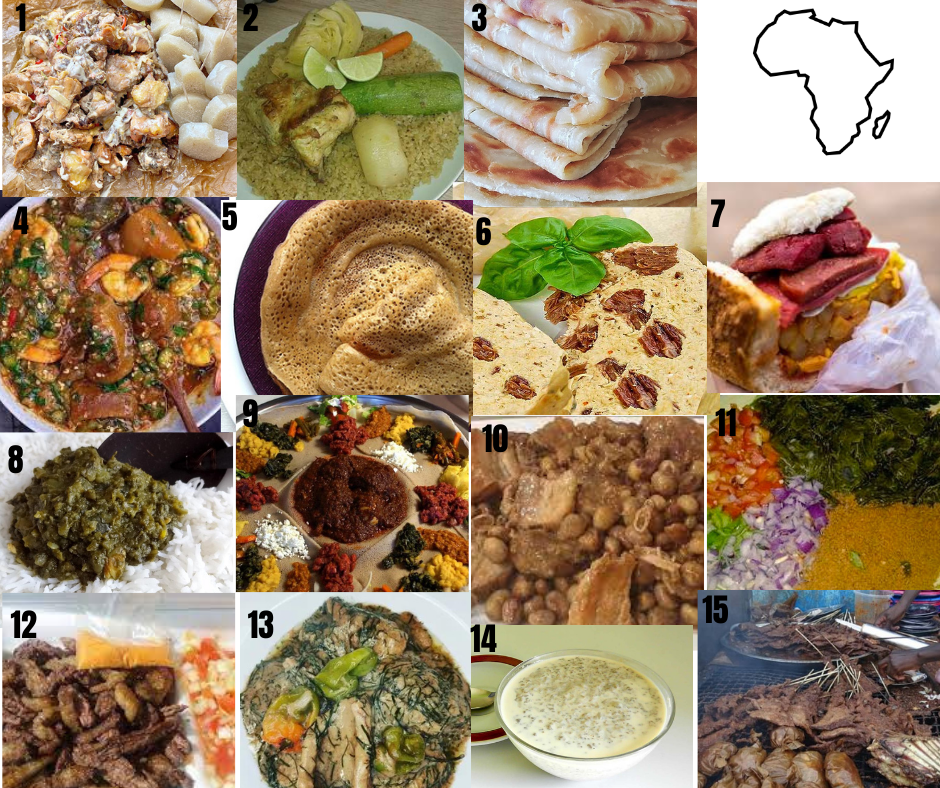
1.Poulet mayo- Congo Brazzaville: A trip to Brazzaville is not complete without a taste of poulet mayo. Pieces of chicken marinated in a sauce with spices, tomatoes, onions, bell peppers, and a generous amount of mayonnaise. The mixture is wrapped in a brown paper bag and slowly grilled to perfection. The meat comes out tender, juicy and imbibed with mayo and other ingredients. You can enjoy it with fries or preferably steamed cassava paste.
2.Thieboudienne- Senegal: The famous Thieboudienne takes center in Senegal as their national dish. The base is rice with spices, tomatoes, onions, bell peppers, spices, fish stock, and a hearty array of vegetates. The most commonly used are cabbage, carrots, and sweet potatoes. The star of the dish is fish (or sometimes meat). There is the red Thieboudienne with tomatoes and the white one with no tomatoes. I am a fan of the latter.
3.Tchapati – Kenya: A staple eaten around East Africa, Tchapati is a type of soft and chewy flatbread eaten alone or with a side like a savoury sauce or tea with milk. It is made with flour, salt, sugar, oil, and warm water. The preparation and resting time when nailed creates a flakiness that is particular to Tchapatis. When visiting Kenya, it can be found at most eateries, on the side of roads, or at home.
4.Okra soup – Nigeria: Okra is eaten all over the continent but how it is made in Nigeria takes the trophy for me. The soup is made with a mixture of proteins (meat) and fish, as the base. Onions and peppers are all kinds of spices sizzled in red palm oil before being mixed with the proteins. The okra is chopped into small pieces or grounded and added to the sauce. The particularity is adding other vegetables such as Uziza leaves. When all simmers, the okra is mixed with all the ingredients and has a reddish color from the palm oil. Okra soup is eaten with any type of Fufu (staple maize, cassava, or rice flour cooked in boiling water into a thick paste).
5.Lahoh- Somaliland: Mornings in Somaliland are made of hot spicy tea with milk and a plate of Lahoh. Lahoh is a thin flat bread made with sorghum batter that is cooked over a hot flattened iron. The batter is always made the night before and left to rest to make the Lahoh in the morning. It is soft, fluffy, and slightly salted. You can have it plain or with a spread such as butter, chocolate, or peanut butter.
6.Met de Pistache-Cameroon: Cameroon has more dishes than one can count. Met de Pistache is usually found during festive ceremonies or special occasions in households. The dish is made with grounded pumpkin seeds, spices, salt, pepper ground shrimp, fish (dried or smoked), or cooked beef. The ground pumpkin seed is the base and is mixed with all the other ingredients and placed in cooking leaves and tied. The leaves with the mixture inside are then steamed for 14 to 20 minutes, and the result is a delicious, cooked paste that is sliced and enjoyed with another side food item.
7.Kota-South Africa: Kota also known as Spathlo is a street food that will fill your stomach for hours (that is if you even finish it). Kota is half of an unsliced loaf of bread that is hollowed and filled with ingredients. Inside the load, you will find French fries (chips in South Africa), polony, vienna, sausage, fried egg, sliced cheese, onions, and tomatoes (sometimes). It is a food item that is popular due to its availability and affordability.
8.Cassava leaf sauce -Democratic Republic of Congo (DRC): Cassava leaf sauce is found all over West and Central Africa. Various methods are used to cook this leave, the one made in DRC has a special taste in my opinion. The leave is collected, cleaned washed then boiled. The boiled leaves are pounded by hand in a mortar. The grounded leaves are cooked again and other ingredients (meat or fish, spices, onions, garlic, ground peanuts, palm oil) are added to turn it into a sauce. It is usually eaten with rice or starch such as yam. It is a common almost-everyday-dish that is eaten in most households.
9.Injera-Ethiopia: My first taste of Injera was in an Ethiopian restaurant far away from Ethiopia. This staple first feeds the eyes with its presentation before filling the stomach. Injera is a light fluffy flat bread made with fermented teff flour, water, and yeast. The mixture of ingredients creates a watery paste that is poured over a hot surface and cooked to produce the Injera. It is then placed on a large dish and different sauces and vegetables are placed on top. The injera is used to scoop the savoury sides. The placement of these sauces creates a colorful food mosaic that feeds the eyes as mentioned above.
10.Bambara ground nut sauce- Madagascar: Bambara ground nut is a grain legume that originates from West Africa and is found all over the continent. In Madagascar, the nuts are removed from their shells and cooked in water like beans. The cooked nuts are then mixed with onions, tomatoes, pork meat, and spices, turning it into a sauce. It is always served with steamed white or red rice. It is a filling dish that is one of the national Malagasy dishes.
11.Kopto-Niger: Moringa leaves are a superfood consumed for generations around the world. The best way I have seen it cooked is in Niger. Kopto is a national dish in which moringa is the star. Moringa leaves are steamed (sometimes boiled) and then mixed with sliced onions, tomatoes, peanut butter, and spices. The mixture is served with a side of a salad, and a couscous made with rice. The dish is found as a street food or homemade in households.
12.Kapana- Namibia– Grilled meat can be found on streets in many countries around the world. In Namibia, the preparation of this staple hits the palate beautifully. The meat grilled to perfection on a hot sizzling grill is sliced thinly into short meat strips. The meat is always served with a side of tomato and onion salad and hot dried pepper. It can also be eaten with Pap (a type of fufu). Kapana has its headquarters in a neighborhood in Windhoek and a trip to Namibia just isn’t complete without a stop there.
13.Sauce Koko-Central African Republic: Koko (Gnetum africanum) is a leave found around the central African region and used in cooking. In CAR, the leaves are cut into finely thin slices, making them look like grass. The slices of leaves can be found sold in the market in its fresh or dried form. The leaves are then cooked in a peanut butter sauce with meat or dried fish. The peanut butter sauce is first cooked with onions, spices, tomatoes, and the main protein, and the Koko leaves are added at the end and left to simmer for less than 10 minutes. It is one of the national dishes of CAR and is always served with cassava Fufu.
14.Degue -Burkina Faso: One tall glass of Degue feeds the soul. Degue is a beverage found in West Africa but is mainly a key food item in Burkina Faso. The base ingredients are thickened sour milk, sugar (sometimes honey), and millet couscous. Millet flour is mixed with water into a thick paste and formed into tiny round shapes, which are then cooked in boiling water to form the couscous. The couscous is mixed in with the sour milk, sweetened, and chilled before serving. A serving of Degue is filling and a nice dessert that can be enjoyed at any time of the day.
15.Grilled meat -Chad: In the streets of the Chadian capital and all other major cities, grilled meat is found in most corners. There is an array of choices between beef, goat, camel, meat, and sweet breads. The meat is sliced into small triangular pieces, grilled on a slow fire, and served with a lemon and pepper sauce and slices of raw onions. Another form of method of cooking is wrapping seasoned meat pieces in a brown paper bag, tied, and slowed cooked on the grill. All servings of meat are accompanied by baguettes. It is one of the most common street foods in the country.
I believe in the timeless saying if it looks good, eat it. Just the mention of these dishes bring me back to my time in these countries. A taste of food is an opportunity to go on a learning journey about the people who eat it; an equivocal way to build open-mindedness.
Deborah M Ndjerareou
 We Write Afrika
Leave a comment