I first heard of Edna Adan Ismail when I found a Ted talk video she presented on the importance of education to show to my university students at Djabal refugee camp in Goz Beida, Eastern Chad. In the 15-minute, Edna Adan talked about her life story from Somaliland to England, her hardships, triumphs, and achievements in health and education that changed entire communities. I played the video twice in class; students listened and engaged in a debate to work on their English vocabulary and pronunciation. Beyond English, the message I wanted them to understand is what they can dream, achieve, and overcome challenges. The most notable interaction during the class session was from the young women who were happy to see a woman like them that impacted an entire country.
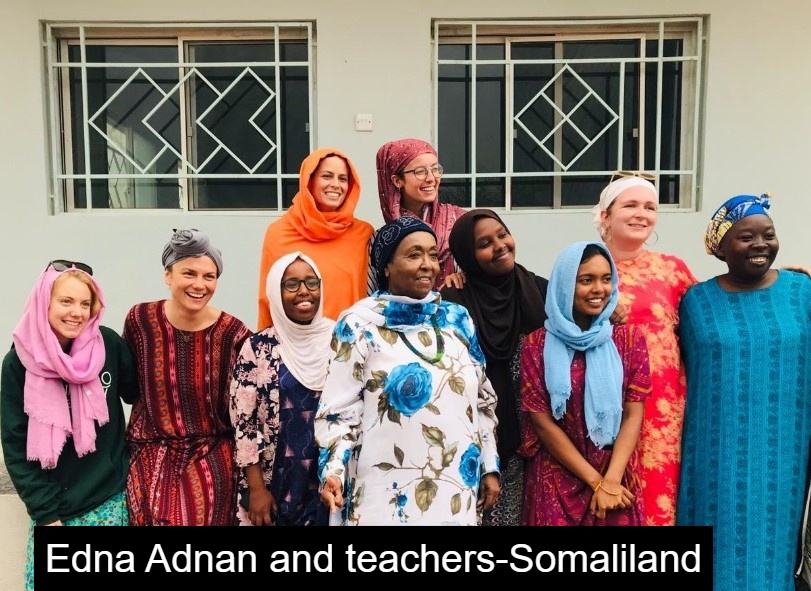
Fate would have it that three years after that class session in Djabal, I arrived at Baliga Gas in Somaliland to teach at a women’s University. One day, the head of the faculty invited Edna Adan, who was back in Somaliland, to come and speak to our students. All students already knew who she was and what she represented for the country and the continent. She is affectionately called the Mother of Somaliland. She talked to the students and faculty, shared stories, and encouraged us in this educational endeavor. With care and humility, she imparted the wisdom of pushing boundaries and creating a space for oneself as a woman.
Having her present on campus was enough to teach our students what vision and perseverance lead them to achieve. Their excitement of seeing one of them gain global recognition for her health work motivated them to study harder. For us faculty members, it was a lesson in believing in a vision. We were a group of women teaching and managing a campus kilometers away from the capital, Hargeisa. We had the broader vision that our work education was a catalytic force for changes in the future.
Edna Adan was born in 1937 in Hargeisa, the capital of then-British Somalia. The daughter of a medical doctor, she studied nursery and midwifery. She is an activist for the abolition of Female Genital Mutilation (FGM). She was the first female minister of Foreign Affairs and served as Minister of Family Welfare and Social Development. In 2002, she opened the Edna Adan Maternity Hospital, and in 2010, the Edna Adan University. She has won numerous international awards for her work in health in Somaliland and worldwide. She remains an emblematic figure for her country. Somaliland is a country that is striving against all odds. Her journey to reach her goals mirrors what the government is achieving. As a woman, Edna is showing us that we can push against the boundaries set for us in society and push toward our dreams.
Edna’s story reminds us of the development we need by Africa for Africa. Her vision is based on her story, surroundings, observations, and struggles. She was there at the field level and saw the need and the type of solutions needed. The voices from the field can create initiatives with a more significant impact. For generations, her initiatives in health and other sectors will serve as the legacy of a woman with the vision and calling to lift her country.
Her work is a perfect example of localization—local and contextualized solutions to solve our challenges. She has proven what women can achieve for their communities, from hospitals to universities. It is a kind reminder to Africans that we can meet our own needs.
Calling Edna Adan, the mother of Somaliland, is the perfect answer to the question of what is the role of women in society. A woman is a catalytic force for her community and her nation.
Deborah Melom Ndjerareou
 We Write Afrika
Leave a comment