Creative minds have always been the heartbeat of society, the quiet force that keeps its stories alive. In each country, there is a book that has changed national perspectives, a singer or actor that the country is known for, and artists who spread a message through various forms. What would literature be like without Amadou Hampâté Bâ in West Africa, and the musical world without Beethoven in Europe? With the technological advances of the world and the current state of affairs, artistic minds may be left in the shadows; however, their presence today is needed more than ever.
I attended a documentary screening in Bangkok titled Thabyay: Creative Resistance in Myanmar directed by Jeanne Hallacy. The one-hour documentary follows the journey of four leaders who turn to music, poetry, and art to lead a peaceful revolution in their country. As I watched, I was struck by how each of them had been uprooted by conflict yet chose not to respond to violence with violence. Instead, they picked up their pens, lifted their voices, and played their instruments to carry messages of peace while preserving their art for the next generation. They call themselves “artivists,” using creativity as both shield and sword in their fight for dignity and hope.
Myanmar has been experiencing varying levels of socio-political instability since gaining independence from Great Britain in 1948. Myanmar has also been known for the massive displacement of ethnic groups such as the Rohingya. The conflict, amongst other regions, is based on the multi-ethnic makeup of the country, leading to power struggles.
More recently, in 2021, a coup plunged the country into civil war, creating more displacements and human rights abuses throughout its territory. It is in this context that communities are utilizing their creativity to advocate for peace through nonviolent means. Their activities, beyond advocacy, are also a way to continue living and hoping while the world seems to be closing in on them.
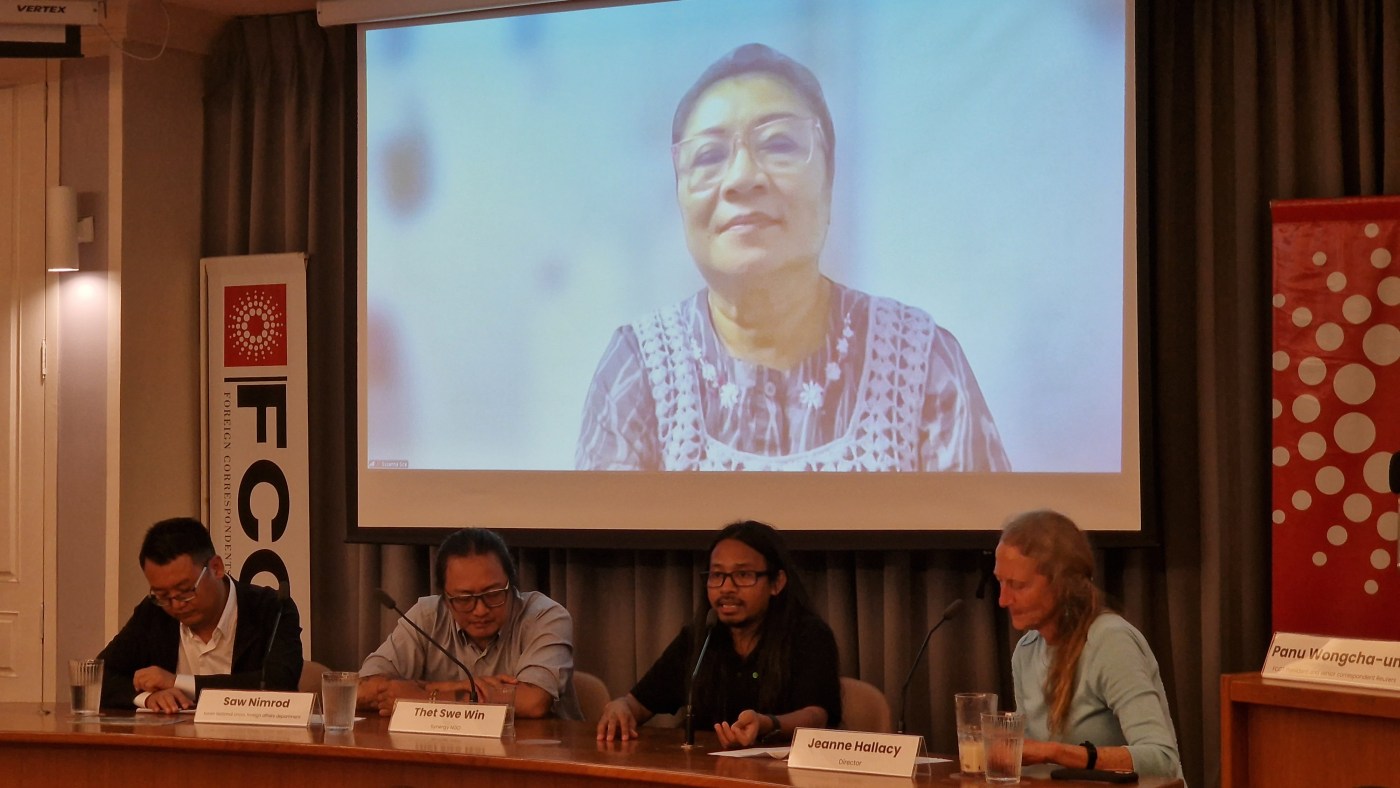
During the screening, two of the leaders featured in the documentary and the director composed a panel that answered questions about the motivation behind the production and the hopes that the activists still hold on to. Thet Swe Win from Myanmar, who spent years in the conflict and is an activist in both the country and Thailand, stated that “you have to feel it to make the change.” This resonates because living through conflict is what drives one to dedicate their life to making change.
Another member of the panel, a violinist who plays and teaches music to young people in his community, explained that being forced out of Myanmar to Thailand led him to spiral into depression and not play the violin for a long time. When he finally joined Joy House, a community of arts and healing in Mae Sot (Thailand-Myanmar border), he began reusing creativity, teaching music, and regaining a certain level of inner peace and joy. He performed three beautiful musical pieces during the evening and stated during the panel discussion, “Thank you for remembering my life.” In response to the audience’s encouraging reaction to his musical performance.
During the Q&A session after the documentary screening, I asked if the production team would also work on translating the film into French and Arabic to ensure that more people, especially on the African continent, could watch it. The themes of war, hope, peace, and creativity, led by the youth, will resonate with young Africans who also face challenges and strive to maintain hope and peace within the continent. The question led to contact exchanges to work on translating the documentary into French.
One of the key messages throughout the documentary is that young people ask the world to see what is going on in Myanmar and not to forget them. I believe that we have that collective responsibility.
Creativity through various means can serve as a powerful force for nonviolence, proving that resistance does not always need to be armed to be impactful. Across history, the arts have bridged divides that politics could not. Today, as the world grapples with conflict and polarization, creative expressions, be it music, literature, film, or digital storytelling, offers a path toward empathy and dialogue.
The stories from Myanmar remind us that peace can be cultivated through human connection and imagination. This lesson is especially relevant for African youth, who face their own socio-political challenges and can draw on the lessons from Myanmar to become “artivists” for change. By harnessing creativity as a tool for peacebuilding, they can inspire unity across cultures and generations. The world needs such art to create bridges that allow humans to cross towards peace.
Deborah Melom Ndjerareou
 We Write Afrika
Leave a comment