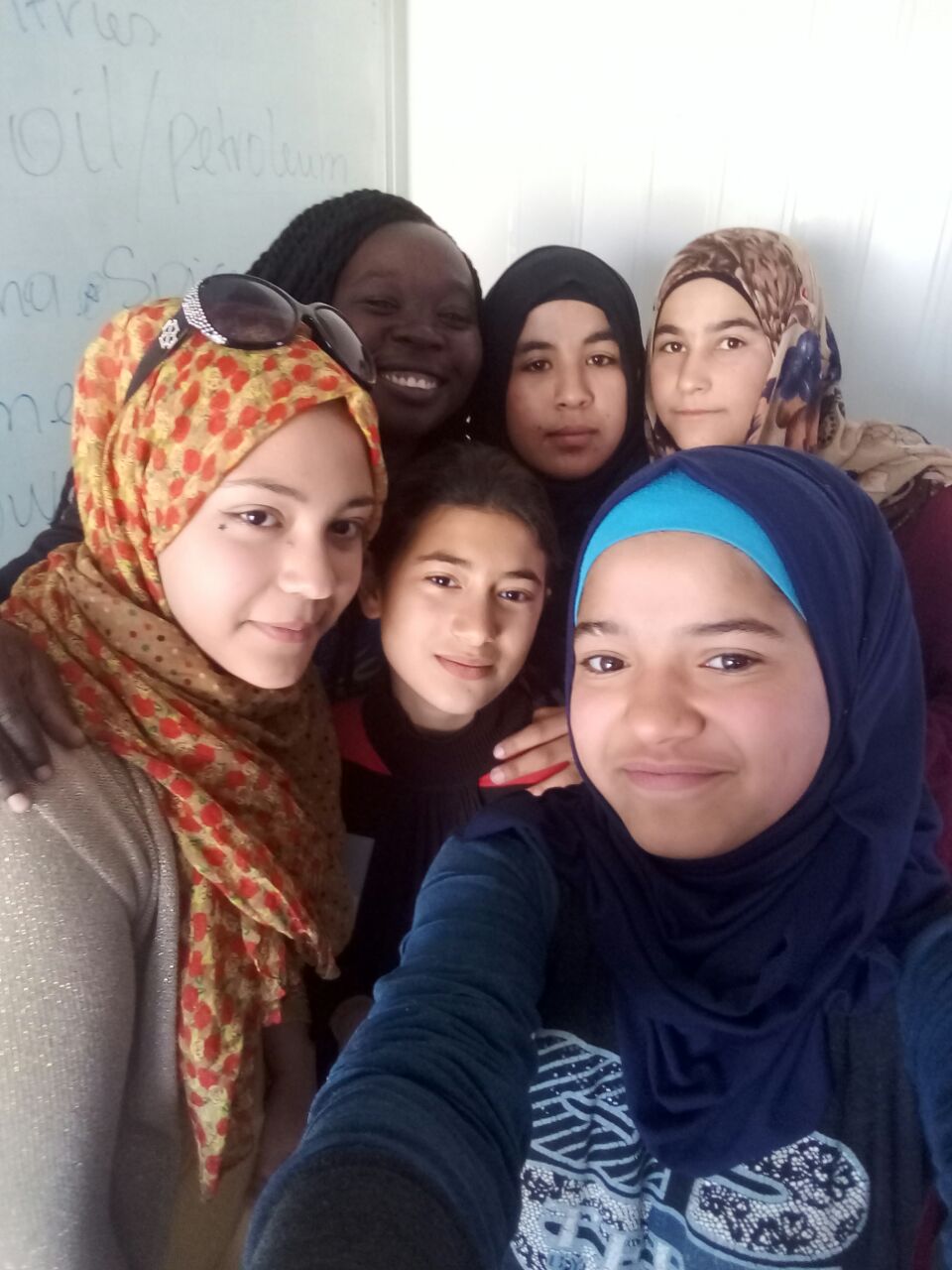
May you one day go home to peace.
The young ones are the first victims of conflicts. Seeing children in refugee camps, and displacement sites shows the destruction of innocence. They will likely not recover from the trauma and carry the invisible scars throughout their lives. When the Syrian conflict broke out in 2011, I was a university student. I remember thinking that the revolutions would be something that would die down soon enough, but on the contrary, it led to a war that went on for over a decade. As I student, I had no idea that one day, I would work with children in a Syrian refugee camp, but life led me there. Recent events in Syria brought me back to those days in Azraq camp where I saw hardship, felt sadness and joy, and shared smiles with children who lost their innocence in a war they didn’t ask for.
In 2018, I didn’t know what to expect on my first trip to the Middle East but my arrival at 3 am in Amman, Jordan had no hurdles. After two questions about why I was there and where I was staying, I received an entry visa. For some reason, fear left my body that day. Travelling alone in a new country and taking a taxi in the middle of the night just happened mechanically. I went to Jordan to teach English in a learning project in Azraq, a Syrian refugee camp located about two hours away from Amman. The project was led by an international NGO that implemented emergency education programs.
On the first day of work, we drove in an 8-seater can drive on a tarred road with empty land on both sides. Once we were outside the city limits, the desert greeted us with occasional sights of trees here and there. My eyes were glued to the window while a colleague in charge of my onboarding explained some details about the camp we were headed to. We arrived at a large gate guarded by men in dark sunglasses. Greetings were shared between them and the driver, we each showed our badges through the windows, and they waved us through; I entered Azraq camp for the first time.
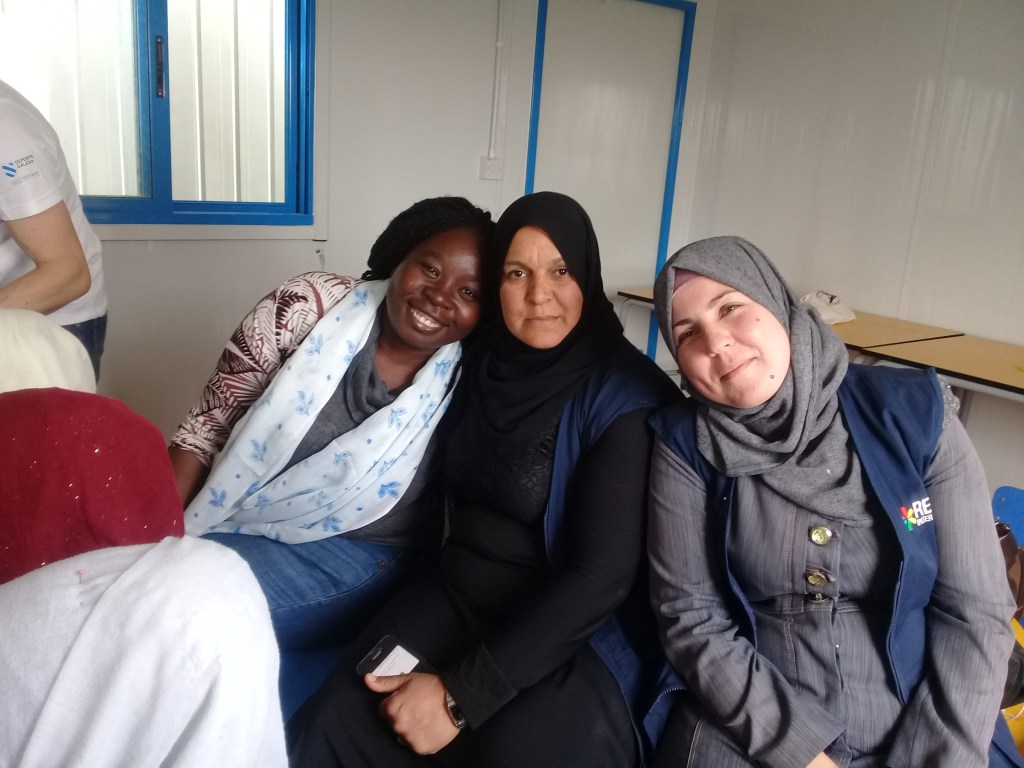
Inside the camp, still no trees, just white mini houses made out of white iron containers, and I learned they were called caravans. Each one housed a displaced family. At 10 am, it was already warm, I was sweating. It made me wonder how hot it was in those caravans. I was welcomed by Syrian and Jordanian teachers also working on the project. Two of them were my co-teachers, assigned to help me manage my classes and translate the lessons for the students when needed.
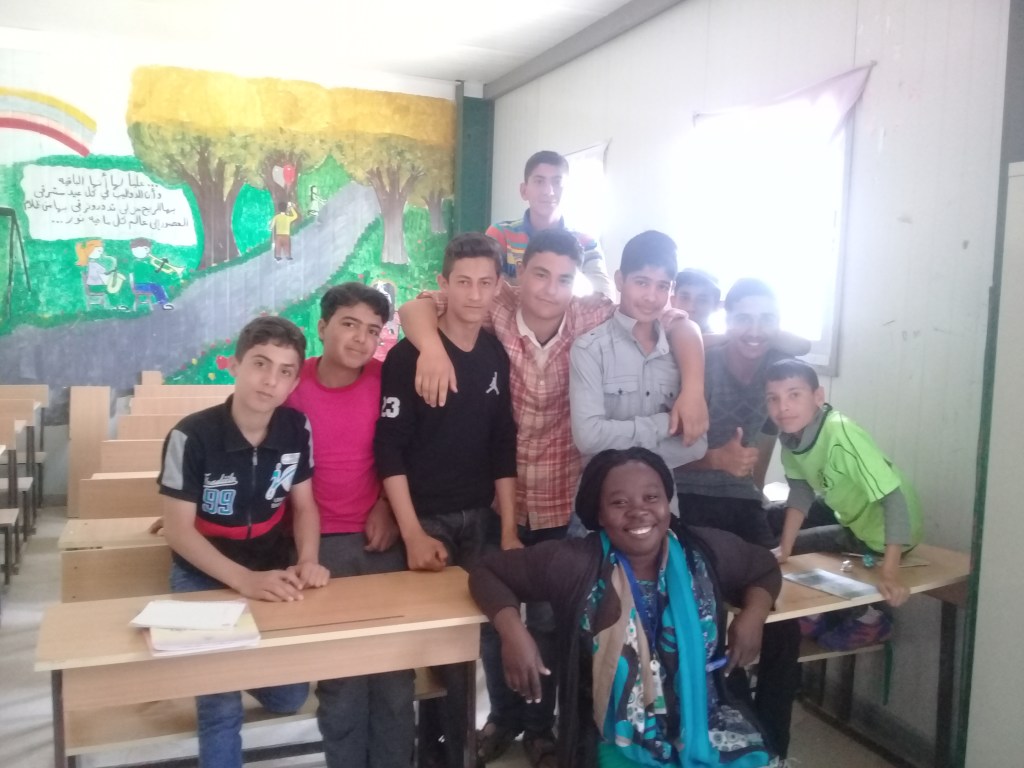
All the students stood up when we first entered a boy’s class. We stared at each other with smiles while the project manager introduced me as their new English teacher. I had about 4 hours of lessons per day between the boys and the girls’ classes. The lessons, more than building their skills, were designed to give them a few hours of happiness. They smiled often. Some were more talkative than others. Some days, we all laughed hard. On other days, silence was welcomed. Silence spoke loudly about what the world was offering them, what they left behind, and what the future might hold. While the conflict raged on, students were hit with news from loved ones every day. If a student missed a class, there was often a reason that could bring anyone to tears.
In the girl’s class, they loved to sing. During short breaks, they offered to let us teachers hear a song from their favourite Syrian artists. The melody, I hope, was a glimpse into another life left behind filled with happier memories. They talked about the food they ate, the games they played, and their favourite TV shows.
One day, one of my students brought me a note. I mentioned in class that I spoke English and Spanish, so the note was written in Spanish by one of her older siblings. It was an invitation for tea in one of the caravans. Oh, how I wished I could go for tea but as a teacher, I was not allowed to visit the families inside the caravans. I thanked her for the note and, through the translation via another teacher, explained that I couldn’t come. I still have the note today.
Throughout the program, the air in the camp was a blanket of emotions. Seeing the white caravans skilfully arranged was a constant reminder of the chaos of the world. The mind has no choice but to imagine what life was like for the refugees before their forceful displacement. What were my students up to with their days in Aleppo, Homs, and Damascus before living in the caravans and attending my English lessons? Were their smiles different? The constant question was why was this happening to children who didn’t deserve it.
My students represented a small percentage of the children in that camp. There were many more living in camps in Jordan, Turkey, Lebanon, and beyond. Azraq camp also brought me back to Djabal camp in Eastern Chad, where I worked a few years prior, where children also bore the weight of conflict. It brought to mind all the refugees around the world. One day they were going about their day, the next they had to flee the consequence of decisions by those in power. It can happen to anyone at any given time.
These past few days, there have been waves of Syrians going back to Syria. It makes me wonder if any of the students in Azraq and their families are part of the movement towards home. Or maybe some were resettled with their families to other parts of the world. One day when I take a walk in the streets of Damascus, Aleppo, and Homs, maybe I will see one of them; surely, I will see faces that look like them.
Deborah M Ndjerareou
 We Write Afrika
wow! This is very powerful. The Human condition. People make decisions that negatively effect people and they don’t realize that it a blink of an eye it could happen to them. No one wishes this upon their neighbor but the ignorance is dangerous. I hope you see one of your students. You never know. They are thinking the same about you and I pray that they Google you one day. You will then be free to have tea with them.
This is an eye opener. You planted good seeds and they will pay it forward.
LikeLike
Thank you, I am glad you like the piece. I do hope I will see them again one day.
LikeLike
Merci pour ce témoignage touchant. Vous mettez en lumière avec sensibilité la résilience de ces enfants face à une réalité tragique. Votre travail est inspirant et rappelle l’importance de la solidarité. Bravo !
LikeLike
Merci pour ce commentaire. En fait, de nombreux enfants sont perdus dans les conflits et font de leur mieux pour rester résilients. Encore merci
LikeLike