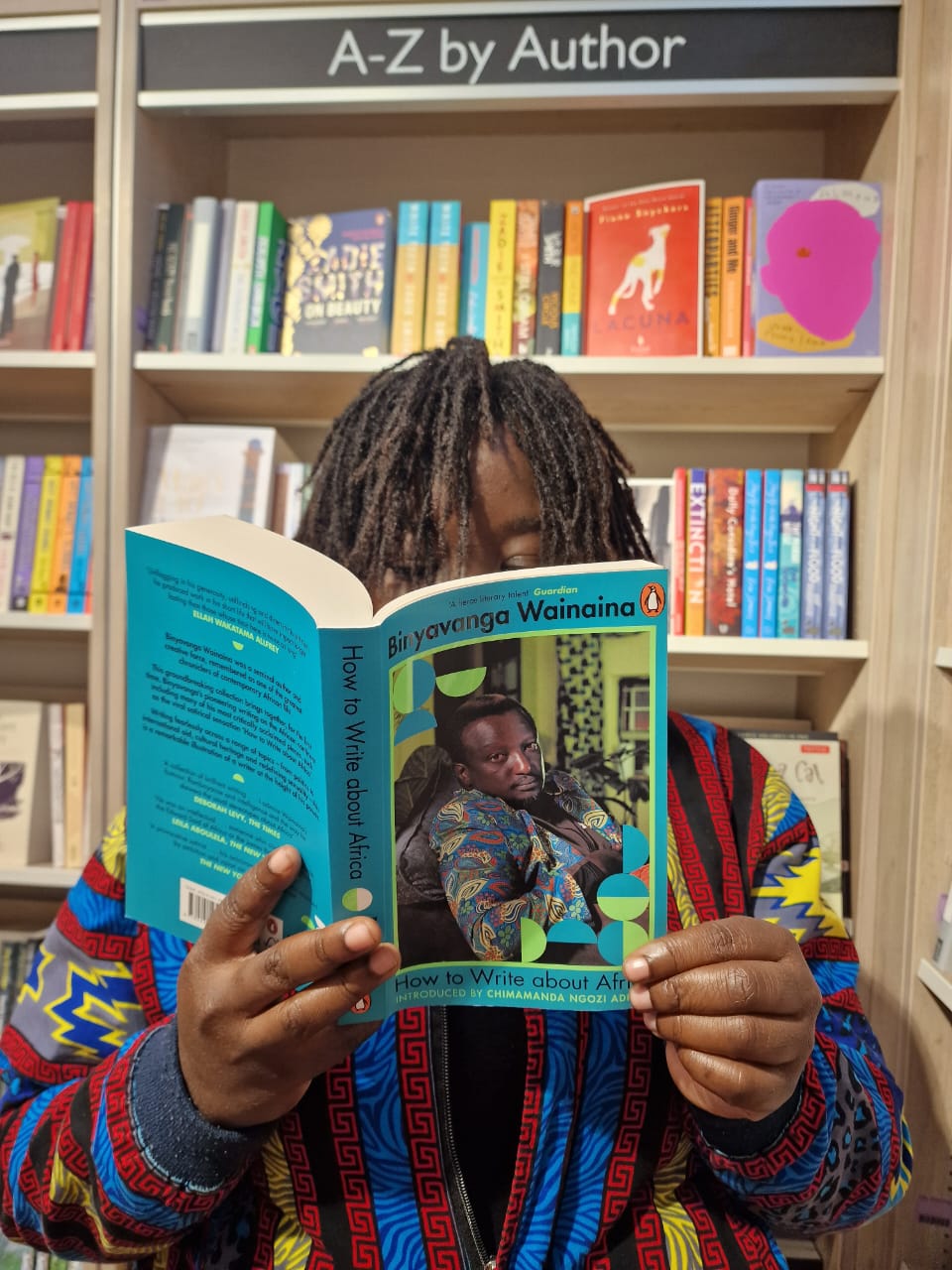
On a trip to London, my fellow bookworm friend Ruwaydah made plans for us to visit Foyles, a renowned bookstore in the city. ‘You would love it,’ she said, and she was right. We both love libraries, so it was easy to spend hours at Foyles checking out books, flipping the pages to get a whiff of the smell of paper, and stopping at the library’s café for a sweet treat.
The afternoon was full of literary discovery though poetry books, Ruwyadah’s favorite, and African literature, my favorite. We were about to leave when a emerald-green book cover with a picture of a man caught my eye on a table display. I picked up How to Write About Africa by Biyanvanga Wainaina, an acclaimed contemporary writer from Kenya. The title alone resonated with me and the brand I started working on for the past two years, so I purchased it without a second thought.
Delving into Binyavanga’s writing style, tone, and point of view on how to write the African continent made me laugh, tear up, and think about the work that still needs to be done in redirecting the world’s perception of Africa. As a great contemporary writer, he uses plain languagFe and observation to depict our realities. I wish I had heard of the author earlier, but better late than never.
Biyanvanga uses satire to highlight the uninformed, stereotypical portrayal of the continent by the world media, international aid, and global narratives. He satirically tells writers that when writing about African, they should insist of poverty; use buzzwords like darkness, safari, and tribal; insist on showing thin looking people; mention that it is a hot dusty place; forget about the 54 countries and present it as one large place; depict the half naked child with a bulging stomach and sunken eyes. Most importantly, do not speak about modernity, technology, and innovation.
Working in the international development sector, these stereotypes are a part of my daily life. Colleagues say the real Africa to talk about the poor parts, which indicates what Africa should look like in their minds. Development programs insist on using colorful language to highlight poverty and show pictures of people looking as desolate as possible. The cherry on top is Non-Africans come to the continent to ‘save us’, show us how to work, and ‘teach’ us new concepts related to our own culture and context. The level of audacity is always out of this world. As the years go by, I believe these stereotypes are not always due to a lack of information, but sometimes a conscious behavior to feed into a superiority complex.
Binyavanga’s satire covers the one-sided way mainstream media writes about the continent, making you laugh and think about how it is. It has been time to challenge the stereotypes and reclaim and rewrite our narrative.
The rewriting movement began long ago and is in its momentum in the past decades. In my quest to join this continental and global movement, I joined this year the Africa No Filter’s collective, joining a community of Africans working through various outlets (media, writing, film, etc.). Africa No Filter is an organization dedicated to shifting stereotypical narratives about Africa through storytelling. Joining the movement is a further step toward my work in rewriting the African narrative one story at a time.
Binyavanga Wainaina sadly left the world in May 2019. His willingness to write and share it with the world has made its mark, leaving behind a contemporary legacy, pushing us to think about the stereotyped views on Africa and how to address them. His book is a reference piece to be read over and over again to that the African narrative rewriting momentum keeps rising.
Deborah Melom Ndjerareou
 We Write Afrika
Leave a comment