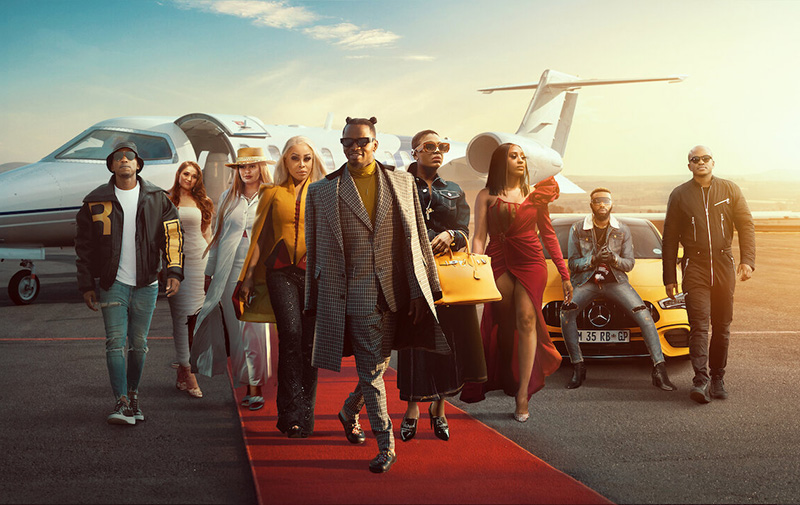
Luxury, youth, entrepreneurship, friendship and drama in Africa on international screens, why not.
On international screens these days, the narrative is shifting. Once in a while, a show emerges that replaces dusty roads, run-down buildings and war-torn areas with luxury cars, state-of-the-art buildings and African outfits with a flair of royalty. This shift, for international eyes, plays an important role in showcasing parts of the continent that the world tends to pass by. There is an important aspect to this shift, as the world needs to see the nuances of Africa that are often overlooked.
Young, African and Famous premiered on Netflix and has been running for three seasons. The premise is based in South Africa with a pan-African cast. The reality show embodies its title, bringing together young, famous Africans and showing their circle of friendship, trials and fallouts. While the premise is similar to many shows out there, it finds its particularity in presenting a sort of new narrative. Opulence, luxury and proud Africans can be something new for the majority of international viewers.
The show is produced by Peace Hyde, a British-Ghanaian media mogul, and Martin Asare-Amankwa, a Ghanaian writer and producer. According to ratings, it topped the African Netflix charts in countries such as Kenya, Tanzania, South Africa and Nigeria. Additionally, a large number of viewers are from outside of the continent, therefore their eyes become a catalytic force in creating a narrative moving away from the stricken poverty image.
Season 1 introduces actress and socialite Khanyi Mbau, rapper Nadia Nakai, award-winning musician Diamond Platnumz, businesswoman Zari Hassan the Boss Lady, radio personality Andile Ncube, celebrity stylist Swanky Jerry, DJ Naked and actress Annie Mcaula Idibia, who is also the then wife of renowned musician 2Face Idibia. The cast represents South Africa, Nigeria, Tanzania, Uganda and Zimbabwe. Season 2 introduced more cast members such as Luis Munana from Namibia and the familiar Nollywood face Ini Edo, as well as more South African nationals.
Putting Nigeria and South Africa together is not a coincidence, for those two are amongst the five powerhouses in Africa. The representation of Tanzania, another up-and-coming economic powerhouse in East Africa, is also warranted.
One of the opening scenes in Season 1 starts with the arrival in Johannesburg of Diamond Platnumz in a private jet, driving to Sandton, also known as Africa’s richest square mile, in a luxury car with Khanyi Mbau. The producers found a way to introduce opulence right from the beginning to keep the audience expecting it throughout.
From one season to the next, we follow the cast on trips to different locations in South Africa. We see the friendships through meet-ups that often come with drama, bickering and leading to fallouts. However, forgiveness and moving on are always just around the corner.
The necessity of this show lies in the importance of showing a picture of the continent that is different from mainstream media. In the words of Khanyi Mbau in Season 1, Episode 1, “Today is a flex night, and I think that it’s time that we as Black, young Africans, we stand together and we stand up and we say to the world we’re not a Third World that the world thinks we are.” She does have a point when she mentions this because today’s narrative shifting is happening through all possible means.
When a viewer, who grew up with the mainstream media’s ‘Third World’ image of Africa, watches this show, they may raise their eyebrows and go on to do more research online to corroborate the images of wealth they are seeing. Having this show on Netflix is a way to widen the international audience for African content and present an angle not usually shown. If Wakanda in the Marvel movies showed a wealthy utopian Africa, this show contributes to showing the reality of Africa for certain Africans.
In all scenes, cast members speak English while adding their languages such as Swahili, Sesotho, Zulu and Nigerian Pidgin, giving the narration a unique flair while promoting the importance of the mother tongue in African culture.
The topics of friendship, love, wealth, African unity, misunderstandings and arguments are ones that any given person deals with every day. The show is unscripted and focuses on the cast’s lives. One might find it trivial to show it on TV, but reality shows are there to entertain and therefore adding a level of drama is necessary.
We still do not know what the next seasons will bring, but adding more cast members from other African countries, perhaps from francophone countries and even the Maghreb, would add great dimension and depth to the show. Filming the cast group trip in another country would also be interesting for us viewers to see opulence and culture in another part of Africa.
While on the topic of angles that could be interesting, having the cast members show what they do for philanthropy within the continent or beyond would be effective in showing how they use their wealth to address issues in the continent. Yes, we do see wealth and it does not take away from the fact that there are needs and underprivileged communities that need a hand. The interesting part would be to show the world that Africans can also take care of their own rather than waiting for international aid.
There are many takeaways from this show, both positive and not so positive. It is not representative of all of Africa, but it does give a glimpse into the possibilities for a number of Africans. We must also remain cautious about the perception of elitism, and this could be addressed if more cast members were added or if activities that give back were shown. However, one of the key messages one can take is the rebranding and image shifting of the continent dubbed as Third World. If the cast members’ lifestyles and endeavors help push forth a narrative of an Africa where business, entrepreneurship, entertainment and wealth are possible for its inhabitants, then why not.
Deborah M Ndjerareou
 We Write Afrika
Leave a comment