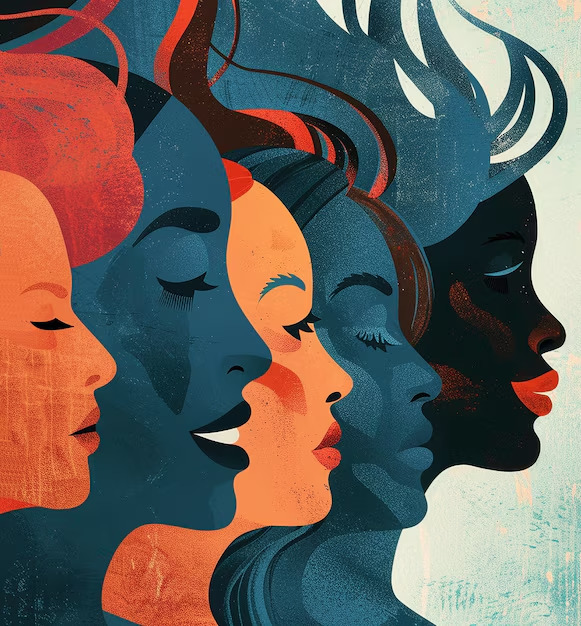
When we reflect on the space occupied by women and the role society assigns to them, we may wonder whether it is different from or similar across the world. Three voices of women from Namibia, Côte d’Ivoire, and Bangladesh take us into their worlds and share how they navigate their societies. They define what it means to be a woman in their culture, their perception of the traditional roles assigned to women, and their relationship with these roles.
Through their stories, we observe that women face many of the same challenges and restrictions. The similarities lie in the fact that certain roles are predefined, and women are expected simply to follow them. Each woman, depending on her culture, may benefit from certain advantages but also encounters obstacles. Some also find refuge in subcultures where their dreams and aspirations can flourish.
Ruwaydah Hossain – Bangladesh / United Kingdom
As a girl, run toward your goals and ambitions if you can. You will inspire many others to do the same.
My name is Ruwaydah. I am a psychotherapist and a teacher. I was born and raised in the United Kingdom. My family comes from Bangladesh, so I grew up in a blend of English and Bengali cultures.
In my Bengali culture, being a woman means juggling multiple roles in both the professional and personal spheres. Patriarchy dominates, yet women play the role of the one who keeps the family united. At home, they take care of domestic tasks and occupy a subordinate position. They must demonstrate their strength in silence while remaining in the background. We grow up in a strict religious environment, also governed by men, which affects our psyche and our daily lives. I believe this reflects the experiences of many women around the world.
Growing up between two cultures taught me to remain invisible while working hard and persevering. I read a lot, and the way women were perceived in the United Kingdom influenced my beliefs from an early age. Around me, I also had aunts who had lived in the country longer and had adopted English culture, opening my mind to other ways of thinking.
Balancing my Bengali culture in an English environment was not easy. I had to embody my culture through my behavior, clothing, and food while living in the United Kingdom. I wanted to be accepted by the English and feel integrated, which pushed me to make efforts. I remember that in primary school, I did not want to spend time with other Bengali children or bring traditional food for lunch. I wanted to be different from the other Bengali students so that I could better integrate with the English. This constant balancing between English standards and the expectations of Bengali culture pushed me to create a third space for myself.
Since childhood, I dreamed of being a warrior like Mulan or a fictional character from a novel. Yet at home, I was told to stay quiet, not to dream too much, not to stand out or be bold. Meanwhile, boys my age were encouraged to pursue their dreams with confidence. I would have liked to play sports at school, but it was not allowed because it meant being in contact with boys.
I did not allow others to silence me, even though it affected me deeply. I kept a hidden resistance that eventually surfaced as I grew older. After high school, I was expected to marry and live close to my family, but I chose instead to go to university far from home. My surroundings did not welcome this resistance, but I was determined to pursue my dreams.
Over time, I have noticed that these narrow cultural restrictions are slowly changing within my community. Thanks to social media, girls are becoming more open, more daring, and less willing to remain silent little girls. Parents are also realizing that they can no longer impose their traditions on their children. They have no choice but to adapt.
When I think of the Bengali woman, the image that comes to mind is that of a woman with a tight smile, carrying an invisible burden. This burden is all the work she does without complaining, with little support from men. I also see laughter and stories being told. Women raising their children at home while telling them stories, creating family memories.
In my immigrant community, many of these women carry unspoken thoughts. They do not always know how to navigate cultural differences and often have no space to talk about them. For example, as the eldest in my family, I was told from a young age to take care of my younger siblings and to do the housework. There was an unspoken rule about what I was supposed to do, without explanation. As I grew older, I discovered Western feminism, which allowed me to see a parallel reality: how women are perceived differently depending on context.
I still have a complicated relationship with the intersection of Bengali culture and the norms that push women to stay at home and marry as quickly as possible. This was never the life I wanted. My parents were shocked that I did not follow this path. Many women around me were obedient and silent, as society expected them to be. My parents feared that I would become too free, too innovative, and too ambitious, because that would mean I would not obey traditional rules, disrupting hierarchical roles. I believe women should be allowed to assert themselves and pursue the dreams they wish to achieve. Today, I work with immigrant women and young people through education and psychotherapy to give them a voice and a space where they can express their needs. My childhood shaped this dream: creating platforms where they can dare to dream.
Atelma Thanises – Namibia
Do not be afraid to be yourself.
My name is Atelma Thanises. I am Damara, originally from Namibia, and I am currently pursuing a PhD in social services in the United States. I am the mother of a son.
Coming from the Damara tribe in Namibia, my people assign gendered roles to women, placing them as homemakers, pillars of the household, and the glue of the family. In my community, many women are single heads of households, which also shows that they are leaders within their families.
Namibia is a young democratic country. In the early years after independence, education was primarily focused on boys, giving men greater power and strengthening their dominance in several professional sectors. I believe this practice also contributed to the oppression of women and to problems such as domestic violence. In recent years, more emphasis has been placed on educating women and girls to address these issues and reduce inequalities. Today, certain laws promote gender equality to correct this imbalance.
The balance is changing as women gain greater access to education and enter different professional fields. This can be seen in universities where more and more women aim for higher degrees. They are reaching positions of power while men are falling behind.
In my country, I worked in social services, a field dominated by women. This allowed me to realize their strength and to observe how this shift in balance gives them more power. As a woman, this motivated me even more to pursue my studies in this field and to encourage young women to study and dream big, regardless of their field.
I grew up with a traditional view of women. As a child, I lived with my grandparents where gender roles were strict: grandmother in the kitchen, grandfather in the fields. Yet I was allowed to help both in the kitchen and in the fields. This upbringing made me believe that my gender was not a barrier. I felt capable of doing whatever I wanted as a girl and later as a woman. I believe this shaped who I am today.
Another strong image from my childhood is that the women around me were very independent. They lived their lives without depending on men. I think independence is a good thing, but it also has its challenges. It pushes women to do everything on their own without help, for example raising children without support from the father. This represents a huge responsibility for them alone and makes life more difficult. Another observation in my country is the existence of a linear life path: school, employment, marriage. Not following this path can devalue a person in the eyes of others. For example, an unmarried person may not have a voice in family decisions.
Through my education and my community, I have been able to define my own world as a woman. There are certain traditional roles that I accept and identify with, but I do not feel bound by all the rules. My dreams and ambitions do not fit within the traditional mold assigned to women.As a temporary immigrant in the United States, I am still redefining these rules for myself. I am a single mother raising a son in a new culture, so I must create the standards necessary for his upbringing. I also want my son to know that girls and boys can have the same dreams and ambitions. Gender should not dictate what a person can or cannot achieve.
Ophélie – Côte d’Ivoire / South Africa
Being a woman is not a sin. We should not see ourselves as the weaker sex. We are strong, and we must honor our voices.
I am a mother, wife, academic, teacher, daughter, sister, and an Ivorian living in South Africa. I strive to lead a life worthy of the name.
I come from Côte d’Ivoire. My mother is Dioula and my father is Abouré. In both cultures, the man is the head of the family, and the woman is the heart and backbone. She is expected to raise the children, transmit the culture, care for the family, and keep it united. Women carry many responsibilities, but they do so without complaining. They cannot complain because society assumes we have an innate ability to endure everything, as if we were superheroes. Sometimes women must even contribute financially to the household, although this is traditionally considered the responsibility of men.
For me, being a woman in these cultures is complex. It is a deeply respected role because she is a pillar of the family. But at the same time, she is also expected to be submissive. Especially in my mother’s culture, women always come after men. The main lesson I learned from the women around me is that one should never rely entirely on men. I saw my mother work hard, build her own success, and give me everything I needed. This inspired me to work as well to achieve my dreams.
Another key message I received was the importance of being married. It was not always something we desired, but our mothers and aunts raised us with this idea: to become superwomen, to go to school, to excel, to stand tall, but at the same time not to succeed “too much” so as not to intimidate a potential husband. It was a kind of dichotomy: be gentle enough to be a wife, but strong enough to stand on your own. In the end, marriage was seen as essential. The other message was that as a woman you must be strong in order to assert yourself in life and not allow others to walk over you.
Even today, when I walk or enter a room, some people think I am not approachable, although that is not true. I have simply learned to carry myself with dignity, and that has always stayed with me.
In my family, brothers and cousins had more of a voice. Even if we had important things to say, men always had the final word. This continues in the professional world today, where women encounter invisible glass ceilings that prevent them from reaching their full potential. There are policies to support them, but the traditional roles assigned to them continue to penalize them. For example, there may be funding opportunities, but the requirements of the process limit women’s access. Sometimes they must sacrifice their dreams so that men can achieve theirs. Despite progress in women’s rights, many aspects of society still prevent them from fully flourishing.
As for gender roles in society, I have not always agreed with them. I have a complex relationship with these norms because I believe they should be more flexible. Women should be able to pursue their personal aspirations. Not all women want to marry, cook, or have children. We cannot place all women into these rigid categories. In my own home, I am fortunate not to be bound by these rules. At certain moments in my life, I have taken on traditional roles to support my husband, but I have also been able to pursue my own dreams. I like that in my culture the woman is seen as a symbol of resilience, but sometimes I feel that this is taken advantage of. She is perceived as someone capable of managing everything on her own.
Despite the cultural diversity of Bangladesh, Namibia, and Côte d’Ivoire, the stories of Ruwaydah, Atelma, and Ophélie reveal a universal thread: women confronted with traditional expectations while striving to define their own identities. These narratives, although rooted in different contexts, resonate with the realities experienced by many Chadian women, who are often rendered invisible under the weight of deeply rooted cultural norms.
Like Ruwaydah in the Bengali diaspora, Chadian women grow up in patriarchal environments influenced by religion and tradition, where they are expected to be silent, obedient, and hardworking. In Chad, religion whether Muslim or Christian often reinforces gender roles that place women in the background. Age and level of education also play a crucial role. Older women or those with little education, especially in rural areas, are rarely listened to or involved in decision making and are expected to maintain traditions rather than question them. It should be noted that there are examples of women leading decision-making processes, but these cases remain limited.
Atelma’s story, which combines partial acceptance of traditional roles with the pursuit of her ambitions, reflects the tension experienced by many educated Chadian women who are caught between cultural duty and personal aspirations. However, unlike Namibia where women’s access to education and professional positions is improving, opportunities remain scarce in Chad, particularly in rural areas. In these conservative settings, traditional norms still dominate, preventing women from asserting themselves as heads of households or participating in community decisions. Ophélie’s testimony, where the woman is both the pillar and the silenced voice of the family, resonates strongly in Chad, where women are expected to be the heart of the home without always expressing their pain or ambitions.
What unites all these stories is the duality imposed on women: strength and silence. Yet this burden appears even heavier in Chad, where access to education, exposure to the world, and spaces for expression remain very limited. While Ruwaydah and Atelma were able to find new paths through education and migration, the majority of Chadian women remain confined to conditions that stifle their dreams and their voices. Their resilience is undeniable, but as long as space is not opened to them regardless of their age, religion, or social status their stories will remain in the shadows and their potential ignored.
Deborah Melom Ndjerareou
 We Write Afrika
Leave a comment