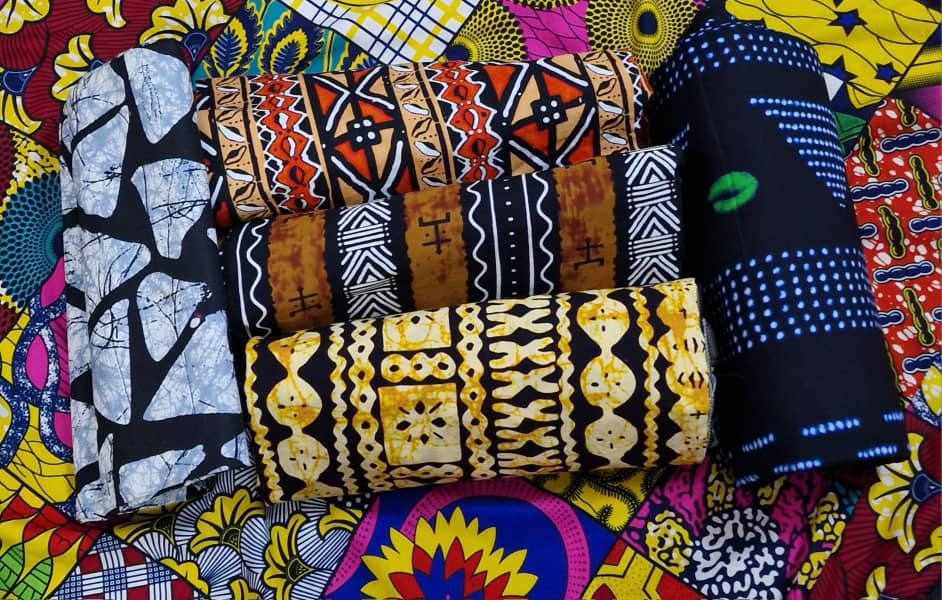
I once heard someone say, “I can’t compete with African elegance.” He is not so wrong, because African fabrics are outstanding across the continent. The fabrics and textiles, combined with the vibrancy of colors and styles of clothing, are eye-catching and ever evolving. From the outside, all African fabrics may look the same: colorful, patterned, and used to create any possible design. They shape identity, mark celebrations, and reflect a sense of pride that is instantly recognizable. They appear unified, but beneath that beauty lies a more complex story of origin, ownership, and meaning.
From a flowy dress to a jumpsuit to a miniskirt, you name it, any tailor can make it. One of the best parts of wearing African fabrics is choosing your fabric, a style, and a tailor to bring it to life. From beginning to end, you are part of the design. The other option is to find ready-made pieces and choose what you like.African fabrics are known worldwide through the clothing they inspire. The most common is African wax, or Ankara, in West and Central Africa.
In a recent documentary by AJ+ , research revealed the true origin of wax and showed that most of the revenue from its production and sales does not remain on the continent. This has long been known, but it is rarely discussed in mainstream media. With the rise of information flow, the topic is now back on the discussion table. According to the documentary, the designs began in Java, Indonesia, most of which was previously known as the Dutch East Indies, where batik was designed and sold. When the Dutch colonized Indonesia between 1800 and 1945, they sought to replicate these designs for large-scale production and profit. However, Indonesians did not buy into the European versions because of their substandard quality. During this same period, recruited African soldiers known as the Belanda Hitam, or Black Dutchmen, who were fighting for the Dutch colonizers, brought these fabrics back to their families in Africa, introducing the product to the continent. The Europeans, seeing this shift, redirected their production toward Africa, producing large quantities of wax for the African market.
African countries quickly adopted the product, making wax a preferred fabric, now widely known as African wax. The prints are countless, and new ones are constantly being created. In the mix, Chinese manufacturers entered the market with imitations produced in China, flooding it at even lower prices. A wax fabric can cost between 14 USD and 200 USD, while the same print made in China can be bought for 5 to 7 USD. Some African countries, such as Ghana, Côte d’Ivoire, Nigeria, and Senegal, began producing locally made fabrics with both traditional and new designs.
One of the main producers of African wax is the Vlisco Group, founded in 1846 by a Dutchman who acquired a textile company in Indonesia. The group produced textiles in the Netherlands and sold them in Africa. Today, if you drive through most cities in West and Central Africa, you will see large billboards advertising Vlisco and sometimes Uniwax. The company owns subsidiaries such as GTP, Woodin, and Uniwax, all based in West Africa and printing locally. About 95% of the company’s sales come from African consumers, and its annual revenue has ranged between 250 and 390 million USD over the last 15 years.
In terms of patterns, original Indonesian designs are still present in the market, alongside new ones heavily influenced by African symbols and traditions. These designs appear across all types of fabrics: European wax, Chinese imitations, and those made in Africa. We now have a mixture of fabrics of foreign origin that have been appropriated into African society. However, the question remains: is it still African, or is it borrowed?
There is a polarized debate on the origins and appropriation of African fabrics. Some argue that African wax has Dutch origins, inspired by Indonesian and other global designs, and therefore is not truly African. Some contemporary critics call for rejecting imported European fabrics and returning to original African textiles.
African textiles have existed for centuries. They were used for adornment, status, and cultural expression. Deeply rooted in tradition, the symbols on these textiles carried meaning. Among others, traditional fabrics include Faso Danfani from Burkina Faso, Kente from Ghana, Bògòlanfini from Mali, Adire from Nigeria, Shweshwe from South Africa and Lesotho, Kuba cloth from the Democratic Republic of Congo, and the purple-blue Tuareg cloth from the Maghreb. These textiles were handmade, and many still are today. This limits large-scale production, making them less present in fast fashion across the continent.
With greater awareness of textile history, consumers are increasingly returning to these traditional fabrics. Platforms such as TikTok, Facebook, and Instagram have become digital marketplaces, where one can observe the rise of clothing made from traditional African textiles. Another emerging trend is the blending of traditional fabrics, such as Faso Danfani or Kuba cloth, with wax. There is also a growing number of designers on the continent creating collections based solely on traditional textiles. These trends are reclaiming the origins of African design and symbolism through fabric.
The question remains: if Africans, as the primary consumers, purchase these fabrics from a European market, what does that say about the African identity of fashion? Do we truly own these designs? Furthermore, what are the economic implications of consuming fabrics produced outside the continent? What if all African fabrics were produced within Africa? How would the hundreds of millions of USD benefit local economies? In terms of identity, what if each textile tied to a national heritage were mainstreamed across the 54 countries and beyond? Could they compete with wax fabric? Most importantly, with Dutch wax accepted and appropriated for decades, could mindsets fully shift back to locally owned and produced textiles?
As African economies grow, with countries such as South Africa, Senegal, Cote d’Ivoire, Nigeria, Ethiopia, and Kenya gaining influence, the opportunity to reclaim both production and profit becomes more tangible. Yet the real shift must begin in the mind. African wax has been embraced, redefined, and lived in for decades, but acceptance does not erase its origins. So the question remains: is it truly ours, or have we simply made it ours? And if it is borrowed, are we ready not only to recognize it, but to invest in creating, valuing, and owning what is undeniably our own?
Deborah M Ndjerareou
 We Write Afrika
Leave a comment