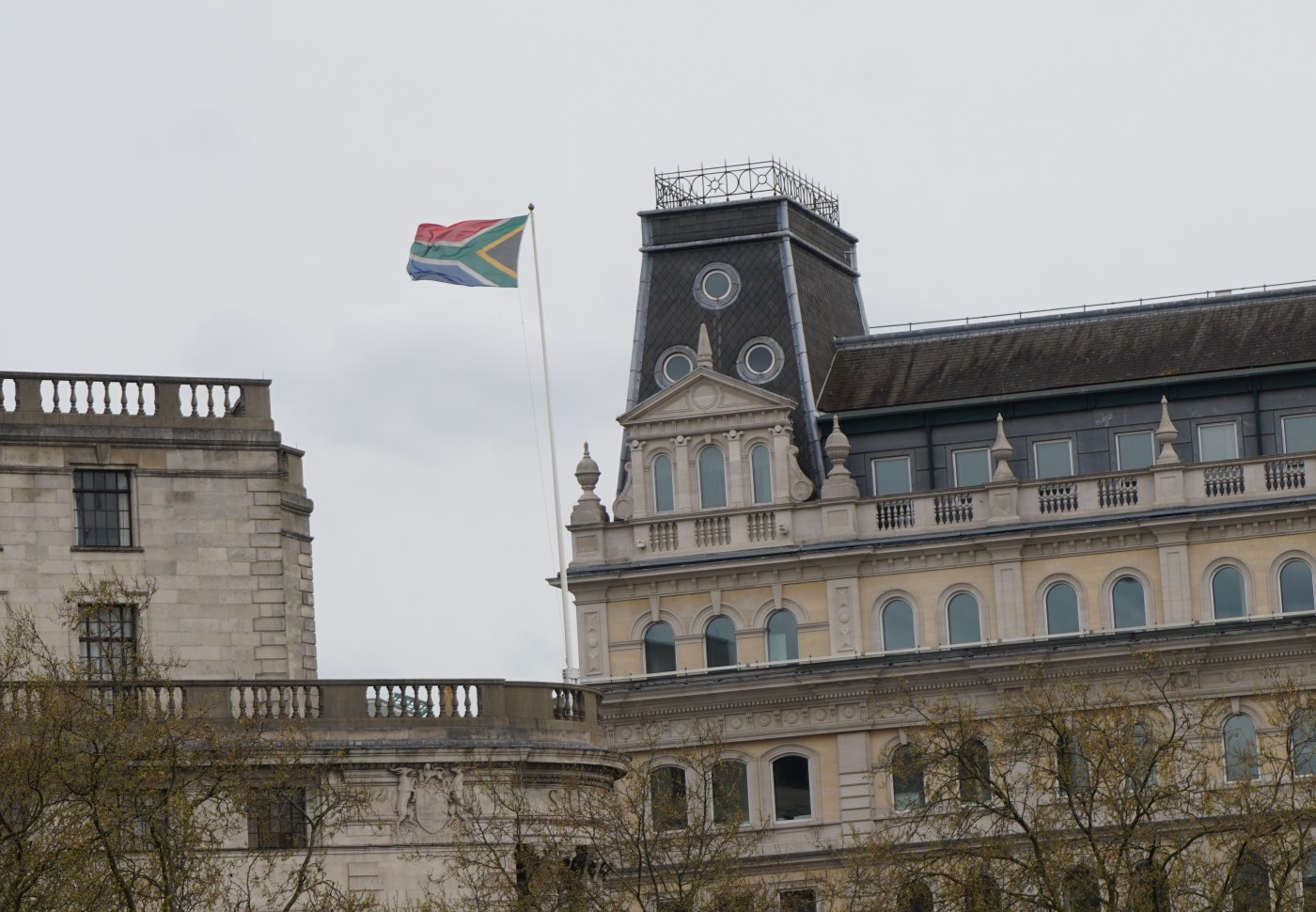
I was around seven years old when I learned how to sing Nkosi Sikelela, the South African National anthem. I knew all the words but had no idea what they meant at the time. I learned it from the Graceland concert video cassette that played at least once a week in our house in Chad. My parents were fans of the South African group Ladysmith Black Mambazo and the singer Paul Simon. The concert organized by Mr Simon concert in Harare Zimbabwe featured other South African legends such as Miriam Makeba, and Hugh Masekela. I memorized songs such as Bring Back Nelson Mandela, Township Jive, and Under African Skies. I still listen to these songs today. That’s when my story with the Republic of South Africa began and starring at Mandela’s statue during a recent trip took me back to my life in South Africa. As the country celebrates Freedom Day and its 30th year of democracy this April 27th, 2024, I touch on my experience and how it shaped my perspective of the continent.
In my last year of high school in the United States, every student was applying and choosing colleges of choice and beaming at the schools they got accepted to. I remember only applying to maybe two or three schools. I knew already that I didn’t want to stay in the United States for higher education for many reasons, one of them being the cost of tuition. I ended up going to New Mexico State University in Las Cruces, because wanting to study Spanish as a major, I figured I would be able to pick the language faster there. In less than a year, it was not what I wanted so I began to look at schools in the African continent. I looked at Senegal, Burundi, and Kenya. The exact details of how I first found the University of Pretoria are not clear to me, but that’s where I set my eyes. After leaving the United States, I took a year off to live in Chad. The time allowed me to work on applying to the University of Pretoria and face the struggles of African intra-immigration. In February 2010, I left Ndjamena for Pretoria and had a life-changing five-year relationship with the country.
I enrolled as a student in the humanities faculty with Language Studies as my major. The first year was the discovery of a new culture, cuisine, and education method that was harder than what I was used to. I must say I was not prepared, but no one could perhaps be prepared. The University of Pretoria, or of “Pressure” as we students jokingly called it gave me a warm and harsh welcome. From the first week, it was clear that it was a fall-in-a-deep-hole and figure-your-way-out setting. Study hard to pass or drop the course and go somewhere else. I struggled through the first year to find my place in the academic setting and South African society. The somewhat American accent that I had quickly morphed into a Chadian-South African accent with a pronounce-your-words-fully with a tad of African intonation and slang such as Neh, Tjoh, and sharp-sharp to spice it up. I completed my first degree in three years and moved back to Chad for a year. I went back to Pretoria for a postgraduate degree and to teach Spanish to undergraduate students. While living in the country, I might not have fully appreciated it as I navigated highs and lows, the beautiful and the ugly. Now that I think about it, South Africa shaped me, my mind and thinking influencing how I see the continent and the world today.
Education
I became fluent in Spanish at the University of Pretoria. This was possible because the university has one of the best foreign language departments in the continent. Leaving New Mexico for Pretoria to learn Spanish was an odd choice, but one that paid off. For some reason at the time, I believed that I could get a good education in Africa as anywhere in the Western world. I did just that. The quality of teaching, I received on the 14th floor of the humanities building was competitive and exposed me to the world through various means. Our faculty put forth the efforts and the resources leading us the fluency in the languages we were studying. My experience cemented the thought that Africa can provide quality education, and I am today proud to be an alumna of the University of Pretoria with two degrees.
Culture
South African culture greets you as soon as land at OR Tambo International Airport through the traditional outfits, art, and music unique to the country of the sub-region. Discovering South African culture is a journey through tribes, history, struggles, trauma, and human beauty. I admire the anthem of the country sung in various languages to represent the country’s inhabitants. In one of my classes titled Official Languages of South Africa, I deep-dived into the history of the languages spoken in the country, the origins, and the implications of declaring eleven official languages. These implications were also apparent at the University of Pretoria as it was possible to study in English, Afrikaans, and other languages. Having that number of official languages brings its sets of challenges, however South Africa made it work.
Another cultural trait I admire is the names in native languages. Previously living in the United States for a few years, I have seen people, myself included, prefer to use names in English to make it easier for teachers and students to pronounce their names. Some classmates from China for example even adopted temporary English names. In South Africa, most first and second names were in the language and no matter where you came from you had to pronounce it right. If you had to learn to click as used in some languages, well figure it out and click away.
Lastly, from my knowledge, no country has the types of amazing culture-imbued graduation ceremonies as in South Africa. Students represent their culture with distinct outfits and walked the stage with cultural swag. I often watch graduation videos on YouTube enjoying the music, dance, and pride.
My African cultural lens has changed into unapologetically representing the continent. From the name to the outfits to the languages, it’s about representing my Chadian and African culture in many shapes and forms when traveling around the world and not being afraid to do so.
Immigration
As soon as I landed in Pretoria, I had a taste of the issues we face with immigration. I mistakenly traveled to the country in the hope of getting my student permit there. The hurdle took about six months or so before I finally saw the piece of paper stuck in my passport that allowed me to study. A dear family friend stepped in to help me get this paper. In the meantime, I was able to attend classes and enter the main library while not fully registered. The University understood the visa struggles and allowed me to study while I waited. The back and forth between immigration offices exposed me to thousands of African immigrants looking to call the country home and some of them received not-so-welcoming attitudes. This was my realization that we as Africans have a long way to go to further integrate cross-borders. In the continent, there have been big strives as we see countries like Kenya and Rwanda reinforcing their visa-free policy for many countries in the continent. In writing and speaking today, I support the idea of a more visa-free policy for all Africans traveling within Africa. For regional blocks, I believe citizens should even be allowed to travel just with an ID rather than a passport. If we are to fully accept each other, we need to have more access to each other.
Ubuntu
I am because you are. The concept of Ubuntu, championed in South Africa, highlights the connection between all humans regardless of who they are. Nelson Mandela’s message throughout his struggle for freedom was equality amongst all. Following the hardships of Apartheid, Mandela advocated for the spirit of Ubuntu showing that humans can seek goodness, hope, and compassion to heal suffering. During my time in the country, inequality internal and external was apparent as society continuously worked to bridge the gap.
After my studies, traveling the world and going through different professional experiences, brings its fair share of inequality. Keeping the spirit of Ubuntu, I remind myself that all humans are equal, and the essence of humanity is our connectivity and ability to share hope and compassion.
My South African experience with its highs and lows reinforced my understanding of human struggle, cultural representation, human beauty, and the need for more African integration. I came out of the country with a sound education and more zeal to showcase Africa in its beauty and struggles. I recently reconnected with my alma mater the University of Pretoria through a mentorship program for undergraduate students and it has been a pleasure.
Deborah Melom Ndjerareou
 We Write Afrika
Leave a comment