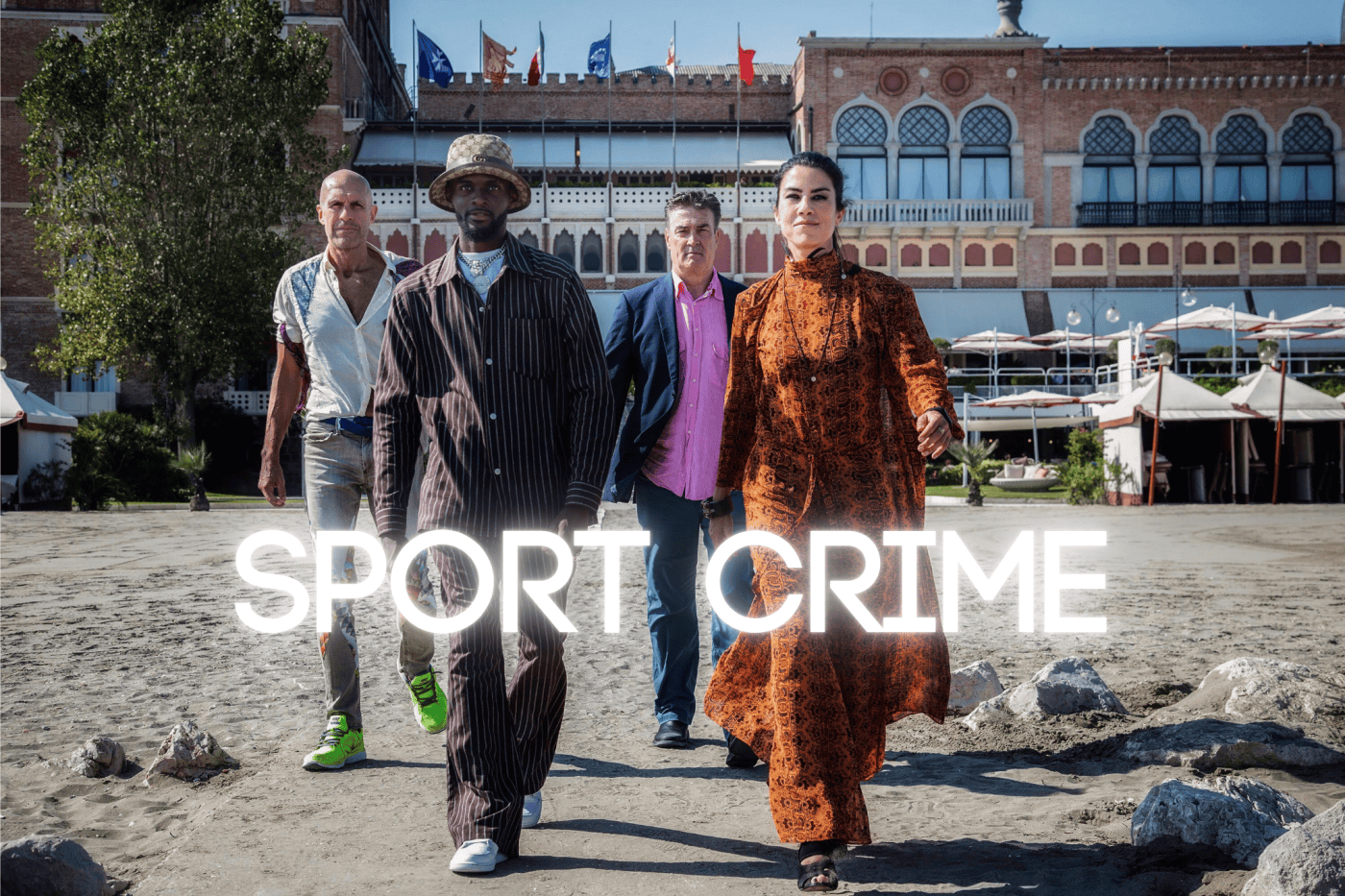
A conversation with the creators and producers of the series Sport Crime. Right to left Daniela Scalia, Daniel McVicar, Toussaint Mavakala, Luca Tramontin.
International television has increasingly drawn on stories of migration, identity, sport and social change to explore the world around us. Yet when Africa appears in these stories, an important question remains: how much space is given to African characters, histories and perspectives, and who gets to tell these stories?
Sport Crime, a television series created by Daniela Scalia and Luca Tramontin, offers an interesting starting point for this conversation. Bringing together sport and criminal investigations, the series draws on the creators’ experiences in sports journalism and professional sport. African perspectives have already found their way into its storylines, including through Jaden Botende, a recurring character from the Democratic Republic of Congo.
Beyond the existing series, the creators have also been considering a project that would give African stories a more central place. The idea, discussed around their participation in AfroCannes (side event at the Cannes Festival), raises broader questions about representation, cultural identity and the relationship between African and European storytelling.
We Write Afrika sat down with Daniela Scalia and Luca Tramontin to discuss the origins of Sport Crime, the place of African characters in the series, and their ambitions for telling stories that draw on the realities of the African continent and its diaspora.
From sport to storytelling
We Write Afrika: Let’s start at the beginning. How did the idea for Sport Crime come about, and what were you hoping to say about sport when you created the series?
Despite the popularity of sport, they felt there was room for a drama series built around sporting investigations. The idea had been developing since 2016, when a television film that served as a prequel to the series was produced.
For Daniela Scalia, the project also grew out of a personal and professional turning point. Having worked as a sports journalist and represented Italy in different sports, she had spent years telling sporting stories. Following a family loss, she went through a difficult period and began reconsidering her professional direction.
She also experienced the limitations faced by women in sports journalism, where youth and appearance can influence how long a woman is considered relevant to the profession. She recalled being told that she had been phased out.
The series offered an opportunity to concentrate on new ideas, tell deeper stories about sport and approach the world from a different perspective.
For Luca Tramontin, sport had always been part of the journey. His experience as a player, commentator and sports analyst provided a wealth of stories to draw from.
We Write Afrika: Both of you come from the worlds of sport and journalism. How have these experiences shaped the way you approach storytelling, crime and the human stories behind sport?
Their approach is closely connected to what they have seen and experienced themselves.
Tramontin has moved between playing, commentary and analysis, including helping teams resolve problems behind the scenes. He continues to train and compete, including alongside younger professionals. These experiences provide material for stories that might otherwise remain unseen by audiences.
The creators fictionalize names and circumstances, but they draw on real situations and observations. They believe there are enough stories to sustain several seasons, partly because sport and the people involved in it continue to evolve. Their preference is for stories that feel possible and recognizable, rather than situations created solely for dramatic effect.
The series also takes an approach to casting that sometimes favors people who can draw on their own experiences and personalities, rather than relying exclusively on established actors. This raises another interesting aspect of storytelling: the relationship between a performer’s lived experience and the character they bring to the screen.
African characters and the question of identity
We Write Afrika: Africa is already present in Sport Crime, including through the Congolese character Jaden Botende and African actors in the series. How did these characters and stories become part of the universe of Sport Crime?
For the creators, the connection to Africa is both historical and contemporary.
Tramontin recalled his grandfather, with whom he grew up, who had been involved in the Ethiopian war and returned with strong feelings about racism and an appreciation for people. His grandfather also spoke to him about Haile Selassie.
Sport has provided another point of connection. African players are part of football and rugby in Europe, and the creators say they build plots around people and situations they know.
They also recognize that the relationship between Africa and Europe cannot be separated from history. These histories continue to shape contemporary societies, even as African communities become increasingly visible across different sporting and cultural spaces.
One of the questions emerging from their work is how to portray African identity without reducing it to a single definition.
The creators referred to a planned storyline involving the kora, the West African string instrument, in which different characters express different understandings of identity. One identifies through nationality, another through being Black, and another through being African.
The question behind the storyline is simple but important: how do people understand themselves, and what does it mean to be African? There are no easy answers. Nationality, culture, race and continental identity can overlap, but they are not interchangeable. An African character should not have to represent an entire continent, nor should the character’s identity be limited to the circumstances of their origin.
We Write Afrika: Jaden is not simply a background character. He is a recurring member of the investigative world, with his own personality, skills and identity. What did you want his character to represent, and how important was it to give an African character that kind of narrative space?
For the creators, Jaden’s place in the series is particularly meaningful because of the personal story behind the actor who plays him.
Tramontin explained that Toussy had been a teenage friend of his son after arriving in Switzerland from Kinshasa. The young man secretly wanted to become an actor. The creators encouraged him, believed in his potential and helped him develop that ambition.
They described seeing his talent early as something they were proud of and giving him a place in the series as a significant achievement. The story illustrates how representation can begin with an individual opportunity. An actor who might not otherwise have found his way into a production becomes part of a recurring story.
But it also invites a wider question. Beyond the opportunity to appear on screen, how can African characters be given the depth and freedom to exist as complete people, with their own motivations, contradictions and experiences?
Beyond familiar narratives of Africa
We Write Afrika: You participated in a conversation at AfroCannes about sport and cinematic storytelling. What was that experience like, and what did being in that African and diaspora creative space make you think about differently?
Tramontin described AfroCannes as a space where he felt able to speak more freely about African history and its complexities. He particularly appreciated the opportunity to discuss subjects that, in his view, do not always receive sufficient attention in European conversations about Africa.
His observation raises an important question about how historical knowledge is produced and circulated. Which people become familiar beyond their own countries? Which histories are taught, adapted for television or brought into popular culture? And whose experiences are treated as part of a shared human story?
International television can contribute to these conversations by introducing audiences to people, places and histories they might not otherwise encounter. However, doing so requires more than placing an unfamiliar name or location into a storyline. It also requires care in how that history is presented and whose perspective shapes the telling. For African audiences, the issue is not simply whether their history appears on screen. It is whether that history is represented with sufficient context and complexity.
We Write Afrika: Where did the idea come from, and what would an African edition of Sport Crime be able to explore that the original series cannot?
For Tramontin, the idea had existed for some time. He wanted the original Sport Crime series to establish itself before pursuing a project that would give African stories a more central role.
He explained that the production had already filmed some scenes in Madagascar, Congo and Tunis. His ambition is to develop specific African stories, not necessarily stories that take place exclusively on the continent.
He acknowledged that Africa has so far been squeezed into the original series. A dedicated project could create more room for particular communities, sports, attitudes and histories that have not received the same attention.
The vision discussed by the creators includes stories drawn from different African countries and regions, as well as the experiences of the African diaspora. They have also considered multilingual dialogue, with characters speaking different languages depending on their backgrounds and circumstances.
The possibility of establishing an investigative agency based in Africa, with Jaden and other characters at its center, forms part of this ambition.
The creators would also like to explore partnerships with African companies, businesses, sporting clubs and other organizations. Such partnerships could help ground the stories in the places and communities being portrayed.
Their stated ambition is to build bridges between Africa and Europe and to create a space where African audiences can recognize themselves in the series, while members of the diaspora can reconnect with places, cultures and experiences that matter to them.
These remain ambitions to be developed. The extent to which they will translate into a sustained African production, with meaningful local partnerships and creative participation, will be important to how the project ultimately takes shape.
Who gets to tell African stories?
We Write Afrika: There is an important global conversation about who gets to tell African stories and how Africa is represented on screen. As European filmmakers looking towards an African project, how do you think about authorship, collaboration and ensuring African voices have genuine creative agency?
Tramontin explained that his decision to keep the project relatively close to himself stemmed from the challenge of finding the right people to collaborate with. His position also reflected a broader conviction: Africa should have the space to tell its own stories.
He expressed frustration with the way European filmmakers approach African narratives, arguing that the continent holds an abundance of stories that remain untold. For him, this raises a fundamental question: why look elsewhere for stories when so much remains to be discovered, explored and told within Africa itself?
His comments reveal an interesting tension. On the one hand, there is a desire to explore African stories and make more room for them in international television. On the other, there is an acknowledgement that Africans should have the opportunity to narrate their own experiences. The question is how these two ambitions can work together.
African stories are not in short supply. Across the continent and its diaspora, people are already documenting their histories, cultures, relationships, ambitions and social changes through film, literature and other forms of storytelling.
The challenge is not simply to discover these stories, but to create the conditions in which they can be told, developed and shared with audiences.
This includes considering who writes the scripts, who makes production decisions, whose languages are heard and who has the final say over how a community is portrayed. Collaboration can take many forms, but the presence of African actors or the inclusion of African locations does not, on its own, establish that African creatives have genuine influence over the narrative.
The creators’ recognition that Africa should narrate itself is therefore an important starting point. How that principle is reflected in the development of a future project will matter as much as the stories it ultimately chooses to tell.
Beyond the stereotypes
We Write Afrika: Finally, what do you hope audiences in Africa and the African diaspora will see, feel or recognize in Sport Crime Africa that they may not often see in international portrayals of Africa? And what would success mean to you personally?
Tramontin wants audiences to encounter the humor and everyday interactions that take place between Africans, including the jokes, conversations in changing rooms, disagreements about food and changing attitudes towards racism.
He believes that some films continue to approach racism through perspectives that feel outdated, without sufficiently acknowledging how it is experienced and discussed today.
He illustrated this concern with the example of a television sports commentator who described a player as having the physicality of an African father and the rationality of an Italian mother. Although the statement might sound complimentary at first, Tramontin found it deeply troubling.
The example illustrates how stereotypes can persist in language that is presented as praise. The assumption that physical strength belongs to one side of a player’s heritage while rationality comes from another reproduces a racial hierarchy, even when the intention is not openly hostile.
It also shows why representation requires more than positive portrayals. A character can be admired, celebrated or presented as talented and still be described through assumptions that limit how their identity is understood.
The creators said they had received considerable affection and gratitude from members of the diaspora in response to the first two seasons of Sport Crime. They see the proposed African-focused project as an opportunity to offer a different face of the continent in international television.
Africa remains underrepresented in many international productions, and its appearances are often shaped by a limited set of familiar narratives. Sport, everyday humour, personal ambition, cultural differences and the ordinary relationships between people can all provide other ways to tell African stories.
The question is how these stories can be developed without replacing one simplified image of Africa with another.
Making room for more than one African story
The conversation with Daniela Scalia and Luca Tramontin offers a glimpse into how African stories are finding their way into international television, as well as the questions that emerge when filmmakers seek to give them more space.
Their experiences in sport and journalism have provided a starting point for exploring worlds and people that audiences might not otherwise encounter. The presence of Jaden Botende also illustrates the significance of giving African characters recurring roles rather than limiting them to brief appearances.
Yet the broader discussion extends beyond one series or a proposed spin-off.
African representation cannot be measured solely by the number of African characters who appear on screen, the number of countries used as filming locations or the number of African stories included in an international production. It also depends on the complexity of those stories, the perspectives through which they are told and the opportunities African creatives have to shape them.
The ambition to make room for Africa is a welcome starting point. But making that space meaningful requires attention to the diversity of the continent, the experiences of its diaspora and the creative agency of the people whose stories are being told.
Ultimately, the question is not whether international television should tell African stories. It is how those stories can be told without losing the complexity, diversity and humanity that make them worth telling in the first place.
Deborah M Ndjerareou


Leave a Reply