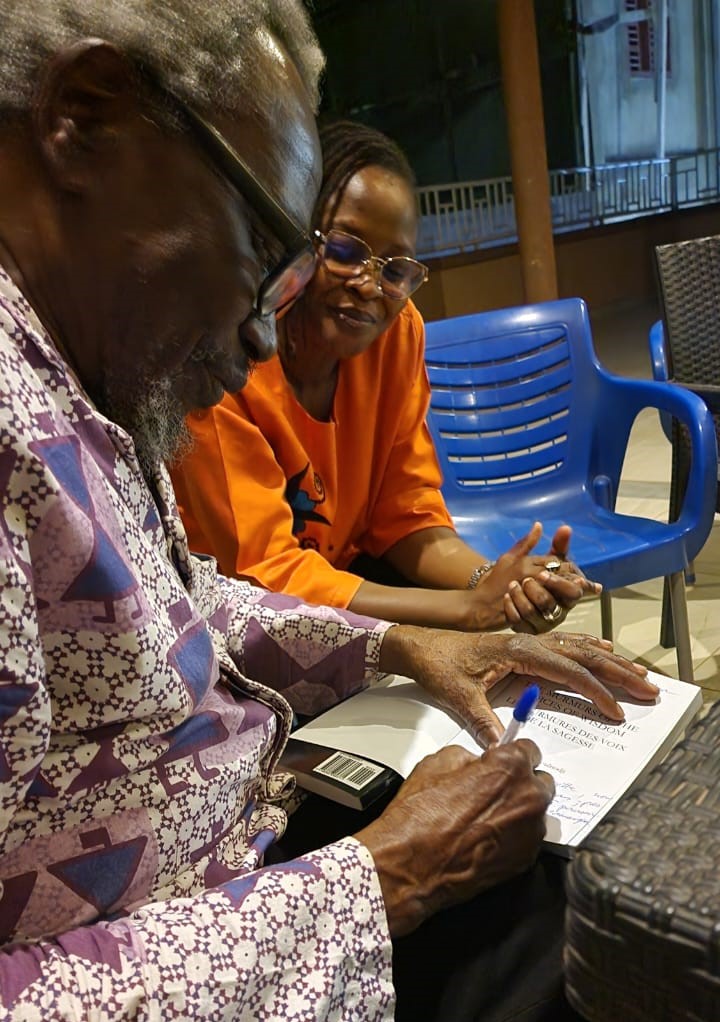
The best part of travelling the world for me is the people you meet and the friends you make. Some you might never see again, but you may keep in touch with them for a lifetime. Those people make the journey more interesting and worth it.
I spent over a year living and working in Burkina Faso and made many friends along the way. One of them is a Nigerien film director bringing African stories to the world.
I met Amina Abdoulaye Mamani through friends, and it took only a few minutes for our conversation to become fluid, filled with smiles and laughter. Through our several meetings, I gradually learned that she was involved in the film industry, while my own research revealed a portfolio that she herself rarely spoke about. It is a body of work that reflects culture, a deep knowledge of the arts, and a passion for telling stories from Niger and across the African continent.
What struck me, however, is that Amina does not only tell stories about her culture; in many ways, she embodies it. You often see her in interviews wearing her head turban and speaking about Nigerien and Sahelian culture. There is something intentional about this representation. She carries elements of her cultural identity into the spaces where she tells these stories, making her presence part of the narrative. Through her work and the way, she presents herself, Amina reminds us that African storytelling is not only about what we choose to tell, but also about who tells the story, how they carry it, and how they choose to present it to the world.
Originally from Niger, she is currently based in Burkina Faso, where she works in film production. Through many cups of tea, our conversations around African literature, cinema, and production have deepened my understanding of that world and made me appreciate the art even more.
She studied filmmaking at l’École de cinéma du Niger and at the École supérieure des sciences de la communication et des médias (ESSCOM), followed by intensive training in France and Senegal.
The daughter of a well-known Nigerien author, Abdoulaye Mamani, Amina is a second-generation storyteller. Her father is best known for his novel Sarraounia (1980), which tells the story of the pre-colonial battle between Queen Sarraounia and French colonial forces, among other works. He also wrote Les divagations d’un nègre hippy, exploring African American characters after the Vietnam War and telling stories that moved between Rome and Paris. His work provided comparative reflections on African Americans and Africans, exploring some of the early relationships between two populations linked by their origins.
Abdoulaye Mamani was a major literary figure in Niger and the wider West African region, as well as a freedom fighter in the struggle for Niger’s independence. Today, his work continues to reach audiences through Amina, who has made a documentary about his life and work.
Amina, quiet by nature and thoughtful, is someone I have come to call “my father’s daughter.” When she met my father, their conversations around passion, African history, and the importance of representation resonated deeply with me. Yet, in her own introspective way, she brings alive stories that are contemporary and deeply connected to our daily lives as Africans.
I once attended the screening of her short film L’envoyée de Dieu (2022), which explores what communities in conflict-ridden areas face. The short film featured a young debut actress who managed to capture emotions of strength, fear, and resilience in just a few minutes, leaving audiences captivated and on the edge of their seats.
She also produced Le silence des papiers (2014), her father’s story told through his writings, which became a precursor to a longer documentary titled Sur les traces de Mamani Abdoulaye (2019). She also co-produced Taajabone (2021).
Her works have been selected for various film festivals in Africa and Europe, and she won the FESPACO prize for documentaries in 2013, among other recognitions.
One can say that quietness and kindness come with art. Amina has an eye for art, capturing the emotions within her stories and transmitting them to her audience. Amina has many more visual stories to tell, and I am certain she will continue to take audiences on an African journey. As she would say as a film director, the ideas and possibilities are endless.
She carries with her a legacy rooted in storytelling, history, and African representation on the global stage. But she is also creating a legacy of her own, one story at a time. I am happy to say that I know Amina personally, and I look forward to continuing to learn from her craft, her perspective, and her passion for African visual storytelling.
Deborah M Ndjerareou


Leave a Reply